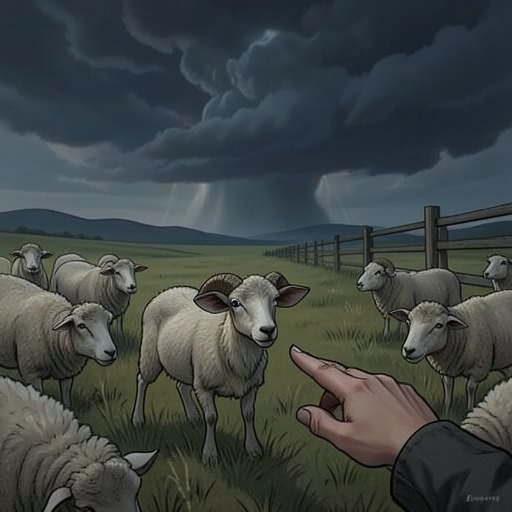
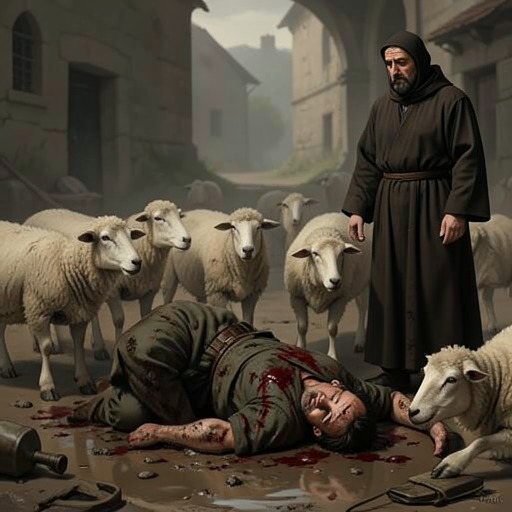
The flock’s murder reenactment at the Smartest Sheep in Glennkill contest
Three Bags FullThe flock’s murder reenactment at the Smartest Sheep in Glennkill contest transforms a sheep competition into a public inquiry: Miss Maple, Zora, Othello, and Mopple the Whale reconstruct George Glenn’s death until Beth’s own account reveals that he chose to die and she helped conceal his suicide. The performance first has to teach its human audience how to read it. Its decisive effect is not merely to imitate a crime, but to make a concealed history visible—and to bring Inspector Holmes, who had been unable to solve the case, to its truth.
A contest becomes an investigation
Inspector Holmes arrives at the contest already frustrated. His Guinness is a duty rather than a pleasure, and the festive gathering of tourists and local people only sharpens his sense of being out of place. He recalls how he had suspected George’s family but found that the red-haired woman had an alibi; faced with the legacies and no clear solution, he had even considered arresting the heirs simply to have an arrest to make. The sheep’s act will overturn that inadequate certainty in public.
The contest’s other performances establish a disquieting contrast. Sheep run in circles at a shepherd’s whistle, leap over obstacles, and respond to signals; one frightened, unnamed brown ewe freezes until her shepherd strikes her with a stick, then races across the platform and falls. The performance receives some applause. Against this spectacle of animals being directed for human approval, George Glenn’s flock comes onstage with a purpose of its own: to get justice out. The stage is still a human-made arena, but the sheep have chosen what it will show.
The bespectacled presenter introduces them under incorrect names. Zora objects, and Othello rejects the suggestion that he looks like a donkey. Miss Maple nevertheless gives the flock its cue: they should follow the plan and remember what Melmoth taught them. Their entrance into the dazzling light begins an act whose meaning depends on the sheep controlling their own movements, rather than simply performing obedience.
Reconstructing the death
Zora begins by lying on her side and stiffening her legs to represent George’s position at death. The first attempt wins scattered applause, but Miss Maple sees that the audience has not understood. Zora tries again more dramatically. The difficulty is not only to reproduce a death, but to communicate its sequence and cause to viewers who do not share the flock’s knowledge.
The reenactment then moves back to George’s ordinary movements across the meadow. Zora takes long, straight steps to represent him, while Miss Maple plays Beth. In the scene, George leaves the steps of the shepherd’s caravan to visit her. Beth greets him, indicates that she wants him to do something, and meets his impatient refusal. She then offers refreshment. Zora dips her nose into an imaginary puddle and drinks; the flock’s earlier alarm at this moment has been too late to stop the represented George from drinking poisoned water. Zora falls again, making the poisoning legible through action rather than explanation.
The sheep give the aftermath its own stage picture. Othello appears as death, a black ram watching over the body alongside Beth. Miss Maple moves Zora back toward the meadow, though the image cannot be made entirely convincing: Zora has to help by pushing with her powerful legs. In the finale, Zora lies rigid on her back, and Miss Maple stamps on her chest with a forehoof in place of the unavailable spade. The flock has rehearsed this effect despite the bruises it caused Zora. Othello remains prowling beside the body as the performance carries George’s death from poisoning to the act with the spade.
Scent, cloth, and recognition
To identify the murderer, the flock relies on scent, a form of evidence it understands but doubts humans can appreciate. Mopple the Whale shakes a rag whose sharp smell the sheep have prepared to resemble Beth’s. Maude found a faint, sourish trace in the toolshed; the flock strengthened it by burying the rag in dirt, covering it with chewed sorrel, and wrapping it around a recently dead shrew found by Heather. Sir Ritchfield took on the task of chewing the sorrel. The resulting smell is not identical to Beth, but the sheep consider the likeness clear enough to guide a human audience with a poorer sense of smell.
The scent is paired with a visible object: a chain with a glittering pendant, like Beth’s. The flock tried to hang it around Miss Maple’s neck, but it disappeared into her thick fleece, so she carries it in her teeth and presents the little cross to the audience while Mopple follows with the rag. This is an improvised translation between kinds of knowledge: scent, compelling to sheep, is given a human counterpart in the chain and cross. Something stirs in the hall; a curse is murmured, glass falls, and the butcher wheels himself up the ramp. The response does not yet amount to a spoken explanation, but the clues have broken through the audience’s passivity.
Mopple briefly leaves the stage for a piece of cake, then returns when the performance reaches its most difficult part. The flock must make Beth’s connection to George intelligible, not simply stage the physical sequence of his death. Its use of the rag and pendant has brought the audience to the threshold of recognition, but the decisive account will come from Beth herself.
Beth’s account and Holmes’s realization
After the sheep’s act, Beth walks down the central aisle holding the rag. She has unfolded it, and the flock can see the pattern of two red signs on a white background. She approaches the stage calmly and sits on its edge rather than joining the presenter on the platform. Holding and carefully smoothing the cloth, she begins by speaking about herself, then connects it to George and to a mistake she had long regretted: she had once put a handkerchief in his hand without saying what she meant, and afterward could neither speak nor act. Seeing the cloth again has made her recognize the importance of that failure.
Beth recounts that George came to her late one evening on the Sunday before last. As on earlier visits, she began speaking about the Gospel. This time he gently stopped her and said the matter was important. She had imagined a different reason for such an approach, but George had something else in mind. Beth says she could not give him the courage to go on and then helped him do it as he wanted, believing that otherwise they would not bury him. He told her that in an hour he would have it over with in the meadow. She went there in the pouring rain and found him already dead. Her account makes clear that the sheep’s staging of poisoning and death by a spade had represented a concealment, not the truth of George’s chosen end.
Inspector Holmes watches the case solve itself onstage. He understands that George died by suicide and that the business with the spade was Beth’s doing. His earlier suspicion of the family and his readiness to arrest the heirs had mistaken a visible murder story for the explanation. The sheep’s demonstration supplies the image that unsettles that interpretation; Beth’s testimony supplies its human meaning. Holmes still recognizes that the lonely man’s reasons cannot be fully understood, but the central fact of the case is no longer obscure.
What the performance changes
The event shifts the flock’s work from private investigation to public disclosure. At first, the humans see a contest act and respond unevenly: Zora’s initial death scene is not understood, the sheep receive only halfhearted applause, and the clues provoke gestures before anyone explains them. Yet the performance’s sequence—George’s visit, the poisoned drink, the body, the scent, and the pendant—creates a structure that Beth can enter and complete with her own testimony.
Its method also preserves a difference between human and sheep knowledge rather than erasing it. The flock makes scent tangible through the rag, translates the pendant into a stage prop, and substitutes Miss Maple’s hoof for a spade. These approximations are sometimes awkward, but their awkwardness exposes the work of communicating across species. The sheep are not simply objects in the contest: they organize the reconstruction, interpret the clues, and direct attention toward a truth that the human investigator had missed. By the time Beth speaks and Holmes understands, the stage has become both evidence and witness.